The Convening Power of Local Authorities
Two things are happening at once, and together they add up to a real opportunity for strong partnerships between local government, schools and local neighbourhoods.
The first is a diagnosis.
Alan Milburn's review into young people and work has put a number in front of the country that is hard to look away from: more than a million young people not in education, employment or training—and rising.
His central finding is not about any single service. It is about the architecture around children: a collection of institutions, built for a different age, that now work in parallel rather than together. Risk is detected early but acted on late. Accountability is everywhere but seldom shared. Most strikingly, for those of us who care about place, Milburn found that the best local leaders are already building coalitions to hold this together, but doing so despite the system, not because of it.
The second is a shift in policy.
For the first time in a long time, the direction of travel is placing local authorities back at the centre of children's lives. Best Start Family Hubs will be in every council area by 2028. Every local authority now carries a statutory target for school readiness. Family help reform is asking services to work as one around families rather than in silos. And a wider devolution of power and money to local and regional governments is redrawing who is responsible for what.
Put those two things together and the invitation is clear. Local authorities are being asked, and (to some extent) resourced, to do the very thing Milburn says is missing: to join up the support around children so that it makes sense across a whole childhood.
The challenge is that the invitation is clearer than the map.
A statutory school-readiness target is not the same as knowing how to meet it. Funding for a new family hub is not the same as a coherent local system. Many directors of children's services I speak to can see the opportunity plainly, and can also see how few worked examples there are of what it actually looks like to build this on the ground. We have plenty of strategies, but there are fewer precedents.
This is where we think local government can lead, and where the role is distinctive.
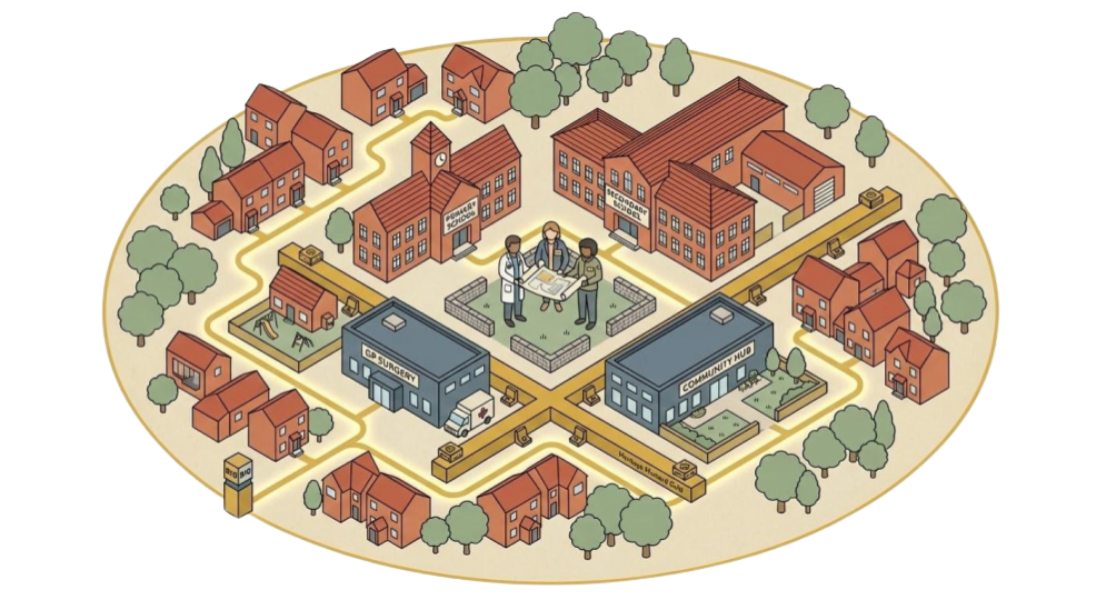
No single school can do this. No single service can do this. But a local authority has significant convening power. In a fragmented system, it can be the body that holds the whole journey of a childhood in view, from a baby's first 1,001 days to a young person's first real step into adult life, and that aligns schools, early years, health, families and community around a place. Milburn describes the best local leaders as civic builders working against the grain. The prize is a system that finally works with them.
At The Reach Foundation, we are delighted to be partnering with a number of forward-thinking local authorities to build coherence around its children. In Staffordshire, Devon and Bournemouth, we are working with councils and their schools to map precisely where children fall through the gaps, to strengthen the relationships that hold a local system together, and to design the first practical moves towards support that is more coherent, more consistent and more connected. It is early days, but they’re live examples of what the direction of travel can look like when a place decides to act.
The right response to the Milburn challenge is not another national programme.
I think it is local leadership, better supported, with a clearer sense of what good looks like. For directors of children's services weighing up what this policy moment asks of them, that is both the challenge and the opportunity: not to wait for a perfect system, but to start building coherence in one place, around one group of children, and to learn from others doing the same.
If that is a conversation you are having in your own patch, it is one we would like to be part of.
by Ed Vainker
Managing Director
The Reach Foundation
With many thanks to Bernie Brown and Staffordshire County Council, Jim Barnicott, Paul Walker, Moira Marder and Matthew Shanks FCCT of the Devon Schools Leadership Service, Lisa Linscott and Kerry Smith at BCP Council, Ann Graham and everyone at ADCS for pushing conversations like these forward.