The adaptive turn
Why “this moment” demands a shift in how we understand and practise school leadership.
by Sam Fitzpatrick
Director of Communications
The Reach Foundation
If the diagnosis presented in the opening frame of this Fieldbook is correct—that the challenge facing school leaders is ecological, instead of purely pedagogical—then it poses a difficult question for every school leader in the country: What are we supposed to do about it?
For leaders watching budgets tighten while needs increase, the reflex is to work harder with the tools we know best: tightening routines, refining the curriculum, and sharpening attendance processes. The logic is seductive: if we can just calibrate the machine of the school perfectly, we can override the headwinds.
And yet, sometimes, those levers feel disconnected from the gears. We pull them, but nothing moves, and the burden feels heavier each time.

To find a way forward, we need to recognise that the tools that served us well in stable times are struggling in volatile ones. We need more than mechanical toolkits to meet an ecological challenge.
The limits of the technical toolkit
Ronald Heifetz, Founding Director of the Center for Public Leadership at Harvard Kennedy School, distinguishes between two types of challenges.
"Technical problems" are complicated, but the solutions are known. If a pipe leaks, we call a plumber. If a child is struggling to decode words, we have a technical solution: rigorous synthetic phonics.
"Adaptive challenges," on the other hand, are murky. Messy. Sticky. The "problem" is often contested; hard to define, let alone solve .
School leaders today are facing a heady blend of both.
Take persistent absence. The "technical fix" is to send more text messages, issue fines, or revise the attendance tracker. But the "adaptive reality" suggests that what drives absence is a fraying social contract between home and school. Many families feel abandoned by the state; many children feel unsafe.
When we apply a technical fix to an adaptive challenge, the problem persists, and trust erodes. We end up trying to "regulate the temperature" in the building, rather than addressing the fire outside (Heifetz & Linsky, 2002).
So, what does the new work look like? We have observed two broad patterns in how institutions successfully respond to this pressure.
The Fortress (microsystem intensifier)
This approach begins with a simple premise: Children cannot learn in chaos.
It accepts that the world outside the school gates is volatile and unlikely to be made more predictable anytime soon. Therefore, the school must become a place of radical consistency; predictable routines, clear expectations, coherent experiences. They “control the controllables.”
This is not about "strictness" for its own sake. It’s about building what Heifetz calls a "holding environment": a space strong enough to contain emotion, uncertainty, and distress so that learning can happen.
“To use the analogy of a pressure cooker, a leader needs to regulate the pressure by turning up the heat while also allowing some steam to escape. If the pressure exceeds the cooker's capacity, the cooker can blow up. However, nothing cooks without some heat.” (Heifetz & Laurie, 1997)
For a child whose life outside school is defined by precarity—housing insecurity, food poverty, parental stress—a school environment of hyper-predictability is not oppressive; it is a sanctuary. When transitions are scripted, when expectations are crystal clear, and when culture is codified, it drastically reduces the cognitive load required to navigate the day.
But this "intensifier" strategy has limits. As the Education Policy Institute (2025) has shown, the attainment gap is now driven almost entirely by the attendance gap. Even the best teachers in the world cannot teach an empty chair.
“Pupil absence is a key, and growing, driver of the disadvantage gap. If disadvantaged pupils had the same level of absence as their peers in 2023, the attainment gap at age 11 (of 10.1 months) would have been almost one month smaller and the gap at age 16 (of 18.6 months) would have been over four months smaller”.
This is where a second type of work emerges.
The Hub (ecological integrators)
The second approach holds another view. It argues that you cannot teach a child who is hungry or traumatised, no matter how slick your classroom routines are. Some barriers to learning sit outside of the classroom, and unless we intervene upstream, the downstream pressures will continue to compound.
We must be careful here. It is tempting to view the "Intensifier" and "Integrator" models as a binary choice, to present a false dichotomy between "control" and "care”, but the data from our current moment suggests a more nuanced reality: the “Intensifier” approach is necessary, but no longer sufficient.
‘Intensifier’ approaches are necessary because, as the cognitive science underpinning the best performing schools in the country demonstrates, students cannot learn effectively in chaotic classrooms. Without the "holding environment" of predictable routines and high behavioural expectations, the school simply mirrors the disorder of the outside world. You cannot teach a challenging curriculum if you have not first secured the environment.
However, ‘Intensifier’ approaches are insufficient for one brutal reason: the best teachers in the world cannot teach an empty chair. This is why the Children’s Aid Society in New York City co-locates health clinics inside schools.
This is why StriveTogether’s partners broker cross-agency partnerships around school clusters. This is why Harlem Children’s Zone integrates family, health and community support into a coherent pipeline in a clearly defined community.
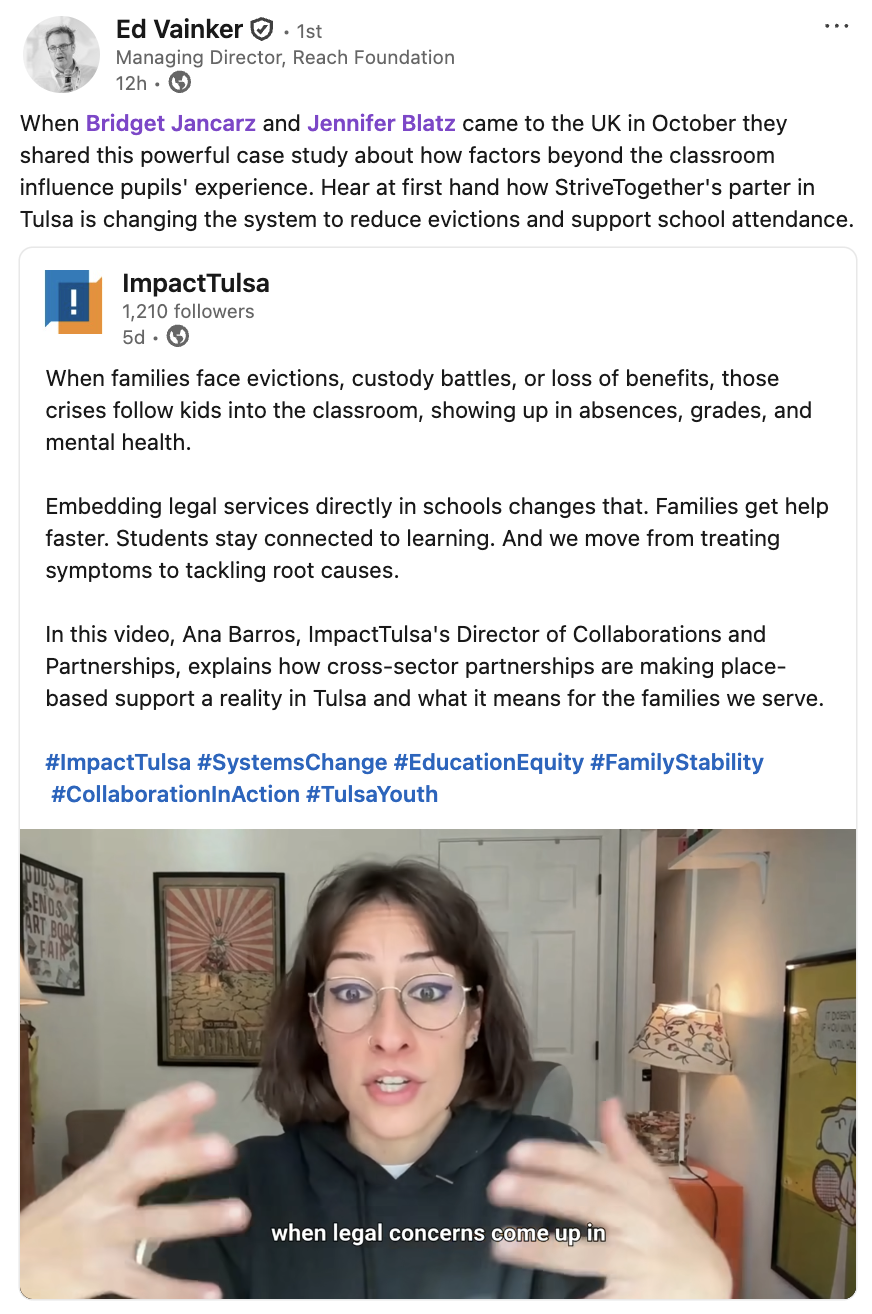
Closer to home, we’ve seen the same logic:
United Learning in Paulsgrove. Their monthly "Coffee & Connect" meetings now convene 51 local partners to coordinate support. Since 2022, over 200 community cohesion activities have run, resulting in attendance improvements of up to 63% for targeted pupils.
Cornwall Education Learning Trust (CELT) in St Austell. All primary schools now use a unified speech and language assessment tool and shared datasets to align early support. This upstream investment has closed the attendance gap: SEND attendance is now equal to overall Year 7 attendance at 97%.
They view the “disadvantage gap” as a failure of the surrounding ecosystem. They intervene upstream by co-locating health services, dental care, and family counselling within the school.
They focus on the “mesosystem”—the connection between home and school—treating parents not as "stakeholders" to be managed, but as partners to be empowered. These approaches dramatically cut the “referral loop”, reduce pastoral workload, and rebuild fractured trust.
The adaptive turn: Rejecting the false choice
The choice is not between “Fortress” or “Hub”; between “intensifiers” and “Integrators”. The reality of our current moment suggests that in order for children to thrive, we need to pursue both.
A Fortress without a Hub becomes a filter. It works brilliantly for the children who can make it through the gates, but it inevitably excludes those with the most complex needs.
A Hub without a Fortress becomes an amplifier. They turn the noise up. Without a calm "holding environment" of consistency and clear boundaries, schools can augment the disorder of the outside world.
The "adaptive turn," therefore, is about executing a double movement. We want environments that are strong enough to create sanctuary and porous enough to enable partnership.
No “mushy middle”
What does this look like in practice? Let’s be clear with what it isn’t.
It’s not a “mushy middle”—a little bit of everything, done slightly frantically. It’s not a straddling strategy where we pile new initiatives on top of already overstretched staff in the hope that something sticks. Nor is it an invitation for schools and trusts to become de facto social workers, housing officers, or CAMHS managers.
If anything, the opposite is true. The adaptive turn is about being more selective, more deliberate, and more honest about what is the work of the school—and what needs to be done with others.
The adaptive turn encourages us to make a subtle shift from spending time to investing it. It’s about reallocating work upstream—into partnerships, early intervention, shared problem-solving—to improve conditions downstream.
When schools host health visitors or coordinate multi-agency meetings, they are not expanding the job, but investing their greatest asset—people’s time—in the conditions that reduce crisis demand, rebuild trust, and ultimately make the core business of teaching more possible, not less.